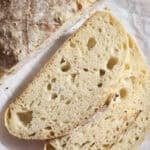
Easy Sourdough Bread (Same-Day Recipe)
An easy, same-day recipe for Sourdough Bread that is a great starting point for beginner sourdough bakers!
Servings: 1 loaf
Equipment
- Dough whisk optional
- Bowl scraper optional
- Round banetton optional
- Bread lame optional
Ingredients
- 150 grams active sourdough starter
- 275 grams warm water
- 425 grams bread flour
- 9 grams kosher salt
Instructions
- Suggested timing: 8am feed your starter, 12pm make the dough, 5pm shape the dough, 8pm bake the loaf. See notes below for more on timing!
- Feed your starter. About four hours before making your dough, feed your sourdough starter at a 1:1:1 ratio. Cover and let rest at room temperature until bubbly and doubled in size.
- Mix the dough. In a large mixing bowl, combine 150 grams active sourdough starter and 275 grams warm water. Mix with a dough whisk (or a wooden spoon). Add 425 grams bread flour and 9 grams salt. Mix with the dough whisk until a shaggy dough forms, and no dry spots remain.
- Optional but recommended: Wet your hands (so the dough doesn't stick to your fingers too much) and transfer the dough to an unfloured work surface. Complete several sets of slap and folds, slapping the dough onto the counter, pulling towards yourself, and folding the dough in half. Repeat for 2-3 minutes until the dough seems to be holding its shape better. This is helping to knead the dough and build gluten structure early on during bulk fermentation. Avoid adding more flour. Wet your hands as needed to prevent the dough from sticking. Return the dough to the mixing bowl (or a clean mixing bowl). Cover with plastic wrap and let rest in a warm area for 30 minutes.
- Stretch and fold #1: After the initial 30-minute rest, complete 3 sets of stretch and folds spaced 30-45 minutes apart (this timing doesn't need to be exact). Wet your hands and scoop under one side of the dough. Pull that side of the dough up, then fold the dough in half on itself. Rotate the bowl 90°, then repeat until you've made 4-5 stretch and folds all the way around the bowl. Cover the bowl and let rest in a warm area. If adding inclusions, add those during this first set of stretch and folds.
- Stretch and fold #2: Repeat the same stretch and folds. The dough should be starting to feel smoother, less shaggy, and hold its shape better. Cover the bowl and let rest in a warm area.
- Stretch and fold #3: Repeat the same stretch and folds. Again, the dough should feel smoother, not shaggy, and hold its shape better. At this point, it should also pass the windowpane test: when you stretch a small piece of dough, it should stretch to the point that light can pass through it without the dough ripping. If it doesn't seem like it's there yet, repeat this process for a fourth set of stretch and folds. Cover the bowl and let rest in a warm area for the remainder of the bulk fermentation.
- Finish bulk fermentation. Bulk fermentation is done when the dough is jiggly, there are bubbles appearing on the surface of the dough, and it is domed. The dough should also no longer be sticky when you touch the surface. The dough will have increased in size by about 50%.This will likely be about 4-5 hours after you have mixed the dough, but will vary based on your room temperature. Check your dough once every hour. If it needs more time, give it more time! Bulk fermentation is the most important part of making a good loaf.
- Shape the loaf. Turn the dough onto an unfloured work surface. You may need to use a dough scraper to loosen the dough from the bowl. Fold one side of the dough into the center, then rotate the dough and repeat, making 4-5 folds around the dough, until the dough feels sturdier. Turn the dough over so the seam is on the bottom. Cup your hands around the dough and pull the loaf towards you, dragging on the countertop to create surface tension. Rotate the dough and repeat, slowly tightening the dough. Repeat until you have a smooth, round ball. Transfer the dough to a lightly floured banneton (the loaf will be upside down with the seam facing up). Cover and let rise. If you do not have a banetton, you can transfer the dough to a bowl lined with a clean kitchen towel and dusted with flour.
- Second rise. Let the dough rise in the banneton for 1-3 hours until it passes the poke test. The dough should spring back slowly when poked with your finger.If the dough rebounds quickly, it's underproofed (give it more time). If the dough doesn't rebound, it's overproofed (bake it anyhow!). This rise is much less important than the bulk fermentation.
- Preheat the oven to 450℉ with your Dutch oven inside. Place a baking sheet on the bottom rack of your oven to prevent the bottom of your loaf from burning.
- Score and bake the loaf. Carefully remove the warmed Dutch oven from your oven. Flip the dough from your banneton onto a piece of parchment paper (or a bread sling). Use a bread lamé or a sharp knife, score the loaf by cutting a seam down the length of the loaf for steam to escape while baking. The cut should be about ¼-½ inch deep.Don't overthink this! And frankly, if you'd rather not score the loaf, the bread will create its own natural seam as it bakes.Transfer the parchment paper and dough into your hot Dutch Oven. Cover with the lid and bake covered for 25 minutes. Remove the lid and bake uncovered for an additional 15-20 minutes until browned and crusty.
- Cool. Remove the loaf from the Dutch Oven and let cool fully on a cooling rack (at least 1 hour) before slicing.
Video
